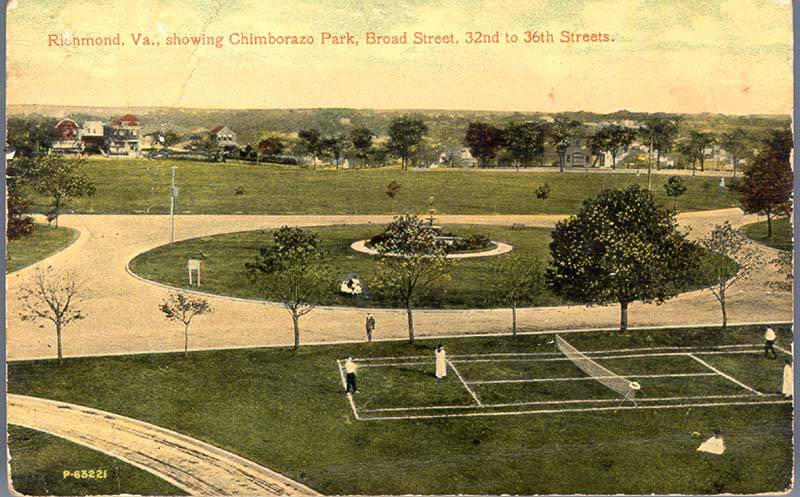
Richmond’s Chimborazo Park has been used as a recreational space for over 130 years. Located in the historic Church Hill neighborhood, the park has witnessed many historic moments and hosted many communities over time, including the Confederate Army, an African American neighborhood, and a National Parks Service museum.
If you visit the park today, you may learn about some of these histories from the outdoor markers. But many more stories are being researched and uncovered to more deeply understand Chimborazo Park’s past. The Conservancy seeks to honor all chapters of Chimborazo's rich history, ensuring its complete story is shared and understood by future generations. We invite you to stay updated as our resident historian continues to uncover and share Chimborazo’s histories on this website.
Early History
In the late 1500s, Pamunkey people inhabited the larger area of Richmond that encompassed Chimborazo Hill. In the early 1800s, the hill was mostly an unoccupied grassy area outside of Richmond’s city limits. By the time of the American Civil War (1861-1865), the Confederate Army built a hospital on Chimborazo Hill. This was one of the largest and best-known Civil War military hospitals that hosted tens of thousands of people for four years. The Confederacy constructed over 100 buildings, mostly in an innovative pavilion style that facilitated circulation of air to reduce disease. The hospital held 3,500 patients at once, treated over 80,000 soldiers total, and employed roughly a total of 950 attendants, many of whom were enslaved.

The End of the Civil War
On April 3, 1865, Union Army troops took possession of Richmond, including the Confederate hospital buildings at Chimborazo that were abandoned by the Confederate Army. Many civilians lost loved ones, homes, and work, especially African Americans who were newly emancipated citizens. During this time, the federal government created the Freedmen’s Bureau of Refugees, Freedmen, and Abandoned Lands and established stations throughout the South to help all war refugees and provide relief in terms of clothing, shelter, transportation, work, and food. The Freedmen’s Bureau established several offices in Richmond, including at Chimborazo, to issue rations and provide provisions and shelter for many displaced white and African American refugees. By July of 1865, the abandoned hospital buildings at Chimborazo Hill were home to more than 2,500 people, mostly newly emancipated African Americans [see figure 1 and 2].
Community and Education in the Reconstruction Era
The Freedmen’s Bureau prioritized helping freed people receive an education, and they created a school system at Chimborazo, mainly staffed by teachers from the American Missionary Association (AMA). By 1866, Chimboarzo was one of ninety Freedmen’s Bureau school sites in Virginia. The right to literacy was previously illegal for enslaved people, as Virginia and other Southern states passed laws prohibiting enslaved literacy after a slave revolt led by Nat Turner in 1831. At Chimborazo Hill, freed people sought to exercise their new right to read and write and began to build their new lives as freed people. [see figure 3].

Community Life & Challenges
Chimborazo Hill’s African American neighborhood faced violent harassment from during this time. One particularly violent episode that resulted in a gunfight and multiple arrests at Chimborazo Hill on March 3rd, 1866 caused the Freedmen’s Bureau to order all “able-bodied” residents to evacuate the area by April 1st. Unfortunately, these racial conflicts occurred regularly throughout the South during the postwar era. Despite these threats, African Americans still gathered at Chimborazo Hill for school, religious worship, and political meetings until 1877. Members of Fourth Baptist Church, today located in Church Hill at 28th and P Street, worshiped together at Chimborazo and conducted baptisms, likely in a spring located near the Richmond and York River railroad. Fourth Baptist served as a vital institution to the larger African American community and periodically hosted political meetings on site. However, the presence of this vibrant Black community led white Richmonders to complain vocally and regularly to local authorities about Chimborazo’s freed community and sign petitions for the creation of a public park at Chimborazo Hill. They argued that a park would improve the area and increase surrounding property values. The city council approved this plan in 1874, and by 1877, despite protests from the community, the remaining Chimborazo residents were forced to move out.
The Public Park and the National Parks Service Museum
The city opened Chimborazo Park by 1890 and it was mostly used by white residents, as an 1859 law that barred African Americans from using public squares applied to Richmond’s public spaces until the Civil Rights Act of 1964. But several sources like the Richmond Planet newspaper provide evidence that African Americans visited the park at times despite legal segregation. Given Chimborazo Hill’s high elevation, in 1906, the federal government purchased five acres of the park to construct a U.S. Weather Bureau station for collecting and reporting meteorological data. In 1959, during a period of national resurgence of white Confederate memory, a local constituency argued to convert the building as a visitor center for the National Park Service’s Richmond National Battlefield Park (RNBP), which was later renamed the Chimborazo Medical Museum. The visitor center’s establishment can be understood as part of a larger backlash to the Supreme Court’s Brown V. Board of Education (1954) decision to desegregate schools, coined as “massive resistance” by vocal and local segregationists such as Senator Harry F. Byrd., former Virginia governor. The medical museum today draws visitors and researchers to learn about medical history of the Civil War in Richmond.
![Postcard of Chimborazo Park [ca. 1920]](https://cdn.sanity.io/images/pntpob7k/production/7e603e36aca99f33006a1f4b743df5ca57fe321e-1024x795.png?rect=0,83,1024,633&w=1200&q=72&fit=max&auto=format)
Looking Forward
Chimborazo Park’s layered histories are continuing to be uncovered today by scholars, researchers, and community members alike. Check back in with the Conservancy’s website to learn more about the park’s history and reach out to our resident historian if you want to learn more or share your stories about the park. We all have the power to help tell the histories of Chimborazo Hill, and this work is just the beginning.
—-
This post was authored by Dr. Laura Fretwell, resident historian of the Chimborazo Park Conservancy and Assistant Professor of Digital and Public History at Florida Atlantic University. Her book manuscript in progress Fighting Forgetting: Recovered Black Histories of Richmond, is about the buried histories and memory of Chimborazo Park over time. If you are interested in speaking with her about this history, or know anyone else who is interested, please reach out to her at [email protected].
All sources cited are at the discretion of Fretwell and Chimborazo Park Conservancy. Please contact them for any questions about citations and/or facts.